For 30 years we have celebrated freedom in Amsterdam — the freedom to be who you are and to love who you choose. Pride Amsterdam has become a staple of the city. The nine-day festival has grown into a world-famous event where the LGBTQIA+ community sets the tone in the city. But it hasn’t always been this way. Pride has had a long and difficult journey. With setbacks and triumphs, the fight for emancipation has made unprecedented progress. Many highs, lows, moving moments and memories to cherish forever. Read the story of 28 years of Pride Amsterdam below.

Since its beginning in 1996 our Pride has developed into a nine-day festival and grown into one of the finest and largest celebrations of its kind worldwide. The city is transformed into a rainbow of events — dance parties, film festivals, sports, debates and culture, a Pride Walk followed by Rainbow Park — and during the closing weekend the city truly comes alive with outdoor stages across multiple locations.
The canal belt is heritage, and what sails along it once a year — our Pride — is heritage too. It’s truly of the same order, and I’m incredibly proud of it!
Femke Halsema
Mayor of Amsterdam

2026: UNITY
WorldPride Amsterdam took place from 25 July to 8 August 2026!
For the first time in history Amsterdam hosted WorldPride. WorldPride is a global event that raises international visibility and awareness for LGBTQIA+ issues. Amsterdam, home to more than 180 nationalities, is one of the most diverse cities in the world. Our vibrant LGBTQIA+ community gives the city a unique atmosphere of freedom, creativity and tolerance. In 2001 the very first same‑sex marriage was held here. In 2026 we celebrated 25 years of marriage equality — a milestone that is still not a given in many places around the world.
2025: LOVE
In a world where division is increasingly prominent, love offers a powerful response. For Pride 2025 the theme was LOVE — not only as a symbol of romance, but as a foundation for connection, understanding and solidarity. Love unites, supports and overcomes.
LOVE is multifaceted: it can mean attraction between people, the support people give one another, and the ongoing fight for equal rights fought together.
New Pride Ambassadors were also introduced, including Rik & Aimee, Sarah Trecia, Janey Jacké, Marleen Hendrickx, Fatih Bici, Gwen Dalin & Sem Jansen.

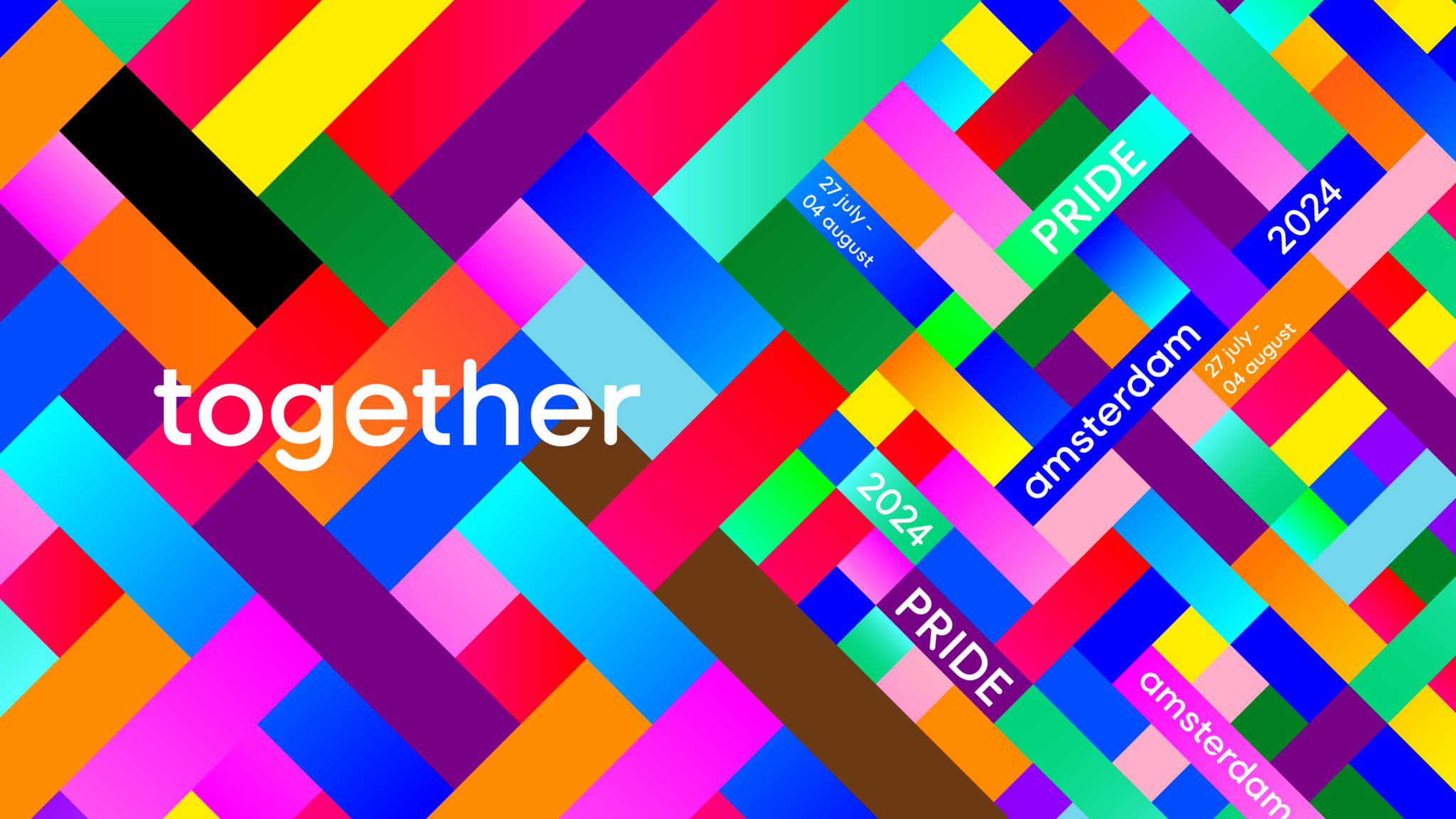
2024: TOGETHER
In 2024 Pride Amsterdam focused on connection with the theme TOGETHER. In a polarising society the LGBTQIA+ community can sometimes end up unintentionally placed against itself rather than standing side by side. Especially at a time when rainbow identities are increasingly under pressure internationally and people are losing freedoms, it’s important that we find each other again. Stronger together, despite our differences. And stronger together because of our differences. We need one another; whether someone is LGBTQIA+ or an ally. TOGETHER in Pride. For ourselves and for others.
We are extremely proud that Nickie Nicole, Inge Lamboo, Karen de Lathouder, Rikkie Kollé, André Donker and Haroon Ali have joined our fantastic Pride as ambassadors from this edition onward.
2023: #YouAreIncluded
Looking back on 25 years of Canal Parade and now with 50 Pride ambassadors each with their own story and struggle, 2023 was a fitting year to take stock. The support from all participants, visitors and partners of Pride Amsterdam is invaluable. That is why everyone was central this year with the theme #YouAreIncluded. With this we show the world how unique Amsterdam is, that everyone matters and that together we fight for a safe future.
Queer Amsterdam provided programming from 22 to 28 July and Stichting Pride Amsterdam from 1 to 6 August. The overarching programme for the two weeks was called Queer & Pride Amsterdam.
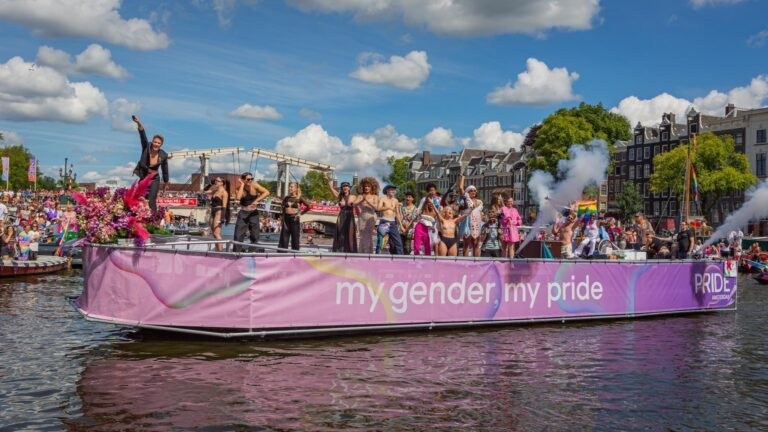
2022: My Gender, My Pride
Everyone should feel free to be themselves, without norms imposed from outside. The reality is unfortunately different and our emancipation is often far from complete. Even in the Netherlands people are still discriminated against and attacked daily because of who they are or who they love. For decades our struggle focused on ‘being allowed to love who we want,’ and it is time to broaden the focus to ‘being allowed to be who we feel we are.’ In other words: it’s time to pay attention to the diversity of gender identities and our right to self‑determination. We have the right to differ from the norm and from the sex we were assigned at birth.
Gender identity was central with the theme ‘My Gender, My Pride’.
Pride Ambassadors: Ahmad Joudeh, Barrie Stevens, BeyonG Veldkamp, Envy Peru, Jason Bhugwandass, Linda de Munck, Paul Morris, Ronald Benita, Suzanne van der Laar and Thorn de Vries.
2021: TAKE PRIDE in us
2021 marked the anniversary year of 25 years of Pride in Amsterdam. That year the theme was ‘TAKE PRIDE in us’.
CELEBRATING DIVERSITY
There was, among other things, a photo exhibition in Vondelpark from 21 July to 10 August and an actual glossy magazine was released. With the photo book and exhibition we looked back on 25 years of Pride in Amsterdam and were moved by images that recall the highs and lows of our festival.
Pride Ambassadors: Axe Leito, Sherry Jae Ebere, Robin Lemònt, Tieneke Sumter, Boris Dittrich and Pete Wu.
2020: The Corona Edition
In 2020 Pride Amsterdam presented an alternative programme to remain visible in ‘corona times.’ In mid‑April the board announced that Pride Amsterdam could not go ahead as planned because of COVID‑19. An alternative programme was created for 25 July to 2 August.
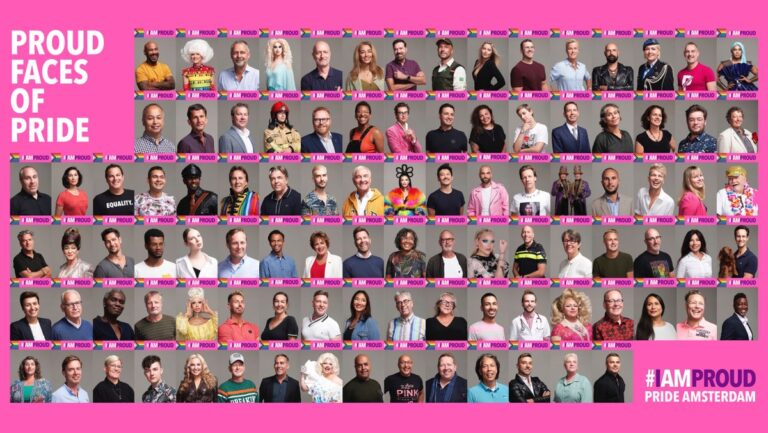
In addition to nine days of live broadcasts on PrideTV and an online demonstration in the Concertgebouw, Pride Amsterdam was also visible across Amsterdam. This included the Proud Faces Of Pride campaign, the Find‑All‑Flags Tour and the call to put out your rainbow flag.
2019: Remember the past, create the future
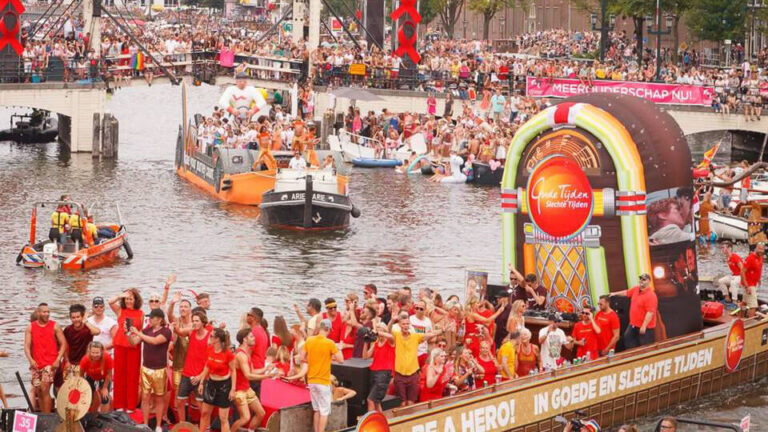
Collaborating partners and organisations celebrating special anniversaries were central that year. These two elements were highlighted during the boat parade with, among others, the Dutch Motorboat, the Political Parties boat and the Higher Education boat. For the first time Badges were sold to boats moored along the quay.
That year’s theme was based on the Stonewall riots that erupted 50 years earlier in New York and mark a turning point in the history of the LGBTQIA+ movement. Pride Amsterdam joined the parade during World Pride New York.
Since July 2019 Pride Amsterdam has been registered in the Inventory of Intangible Heritage Nederland.
Pride Ambassadors: Ellie Lust, Jeffrey Wammes, Raymond Timmer, Victoria False, Dinah Bons, Amber Vineyard and Justin Hermsen.
2018: Heroes
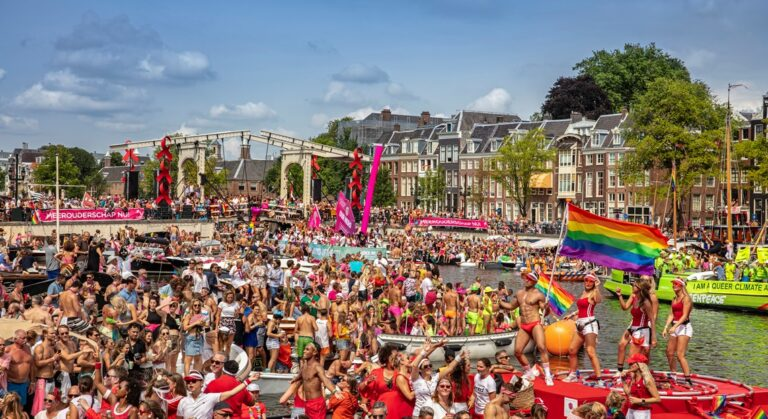
In 2018 Pride Amsterdam used the boat parade to draw attention to human rights worldwide. Boats from Amnesty International, Greenpeace and the Netherlands Institute for Human Rights were named by the organisation as ‘pearls of the parade.’ The foundation ‘Meer dan gewenst’ received the first ‘Support Card 2018’ from Rabobank.
The theme that year was ‘Heroes.’ Everyone knows someone who deserves hero status for what they say, do or stand for — people who take the lead and express their convictions publicly. These can be people who, whether LGBTQIA+ or not, stand up for human rights in general and/or our community in particular.
In 2018 Pride Amsterdam was voted Best Public Event in the Netherlands.
Pride Ambassadors: Jip van Leeuwen, Mieke Martelhoff, Loena Maas, Vanny Reyes, Jackson, Serdar Manavoglu, Francis van Broekhuizen and Jennifer Hopelezz.
2017: This Is My Pride
Many participants used the 2017 theme to raise awareness of serious issues during the famous boat parade. Statements were stronger than ever, with, among others, an Iranian boat and a suicide prevention boat.
To better serve LGBT+ target groups, strengthen content and be inclusive for everyone, the Amsterdam Gay Pride foundation that year reinforced and renewed several existing committees. This gave the nine-day festival even more depth and allowed target groups to better recognise themselves in the programme. The festival was also officially renamed Pride Amsterdam.
Pride Ambassadors: Gebroeders Grimm, Ana Paula Lima, Sjors van der Panne, Souad Boumedien, Niki Today and Shary-An Nivillac.
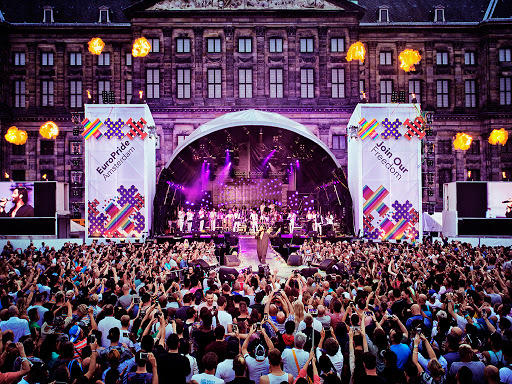
2016: EuroPride – JOIN
In 2016, after 22 years, EuroPride returned to Amsterdam. In September 2013 Amsterdam bid to host EuroPride 2016. Members of EPOA (European Pride Organizers Association) unanimously chose Amsterdam to organise EuroPride 2016. Stichting Roze Zaterdag then decided the capital would also host Roze Zaterdag that year.
EuroPride opened with a unique ‘Freedom Concert’ on the Dam. International artists debuted, and there was a fireworks display.
‘Join our freedom, feel free to join us!’. Director Lucien Spee: “With this message Amsterdam Gay Pride called on European countries where people cannot yet be themselves, live freely, or where human rights are under pressure, to embrace our values and freedoms.”
Unlike previous years, there was no lottery for the boat parade; a special selection committee decided which boats could participate. Highlights in 2016 included Madrid Pride and the participation of Ukrainian performer Kamaliya, often referred to as the country’s Lady Gaga.
Pride Ambassadors: Conchita Wurst, Margriet van der Linden, Valentijn de Hingh, Sipke Jan Bousema, Mayday and Tara McDonald.
2015: Share
The nine-day festival celebrated its twentieth anniversary this year. In many ways the question was reflected on: “What has been achieved in twenty years and what has changed?”.
Among those on the Canal Parade were boats drawing attention to the situation of gay refugees, homeless people, and issues in the Caribbean and other Dutch overseas territories. For the first time there was also an “empty” boat equipped by KPN with a 360-degree camera, allowing people to ‘sail’ along virtually via the internet.
“Sharing multiplies: shared joy is double joy, and that applies to love too,” said Lucien Spee (Director AGP) about the theme. “Sharing means wanting to know how someone else is doing, daring to be yourself, and being vulnerable.”
Pride Ambassadors: Dolly Bellefleur, Emmaly Brown and Raymi Sambo.
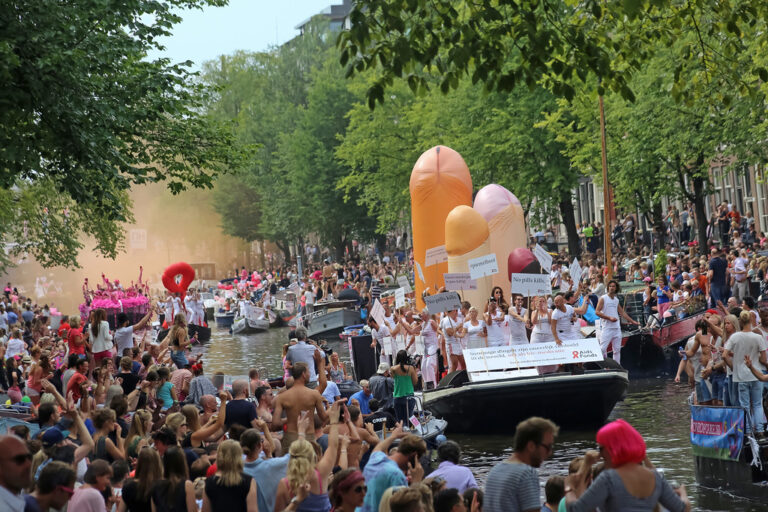
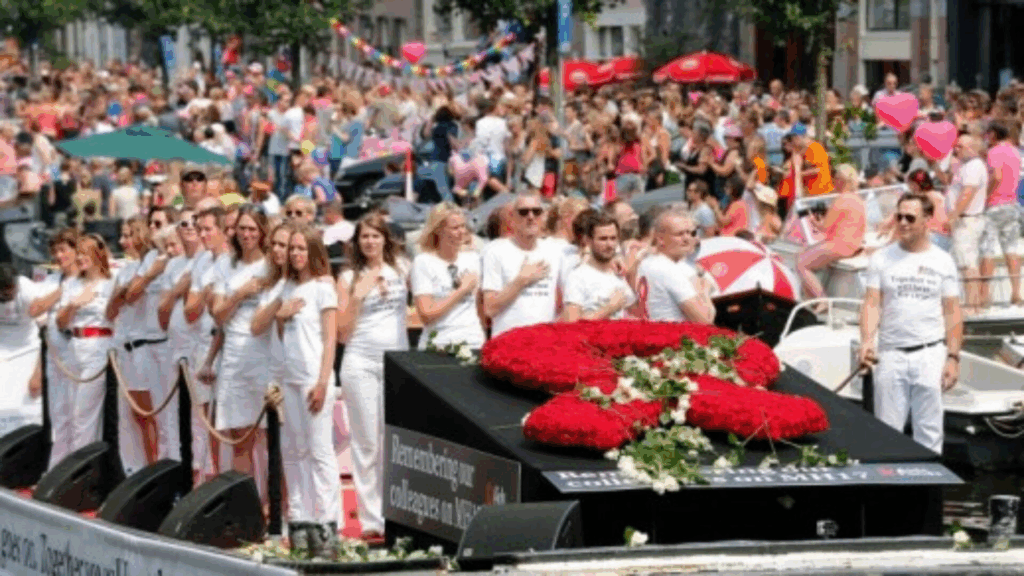
2014: Listen
From 2014 Stichting Amsterdam Gay Pride took over from ProGay with Lucien Spee as director.
The boat parade began with a commemoration for the victims of flight MH17. The Aids Fonds, which lost two colleagues in the crash over eastern Ukraine, led the procession. Other notable boats included the Moroccan boat, an American boat, the AMC Donor Boat, and once again the Jewish boat.
Pride Ambassadors: Siep de Haan, Sjeazy Pearl and Lady Galore.
2013: Reflect
During the Canal Parade of 2013, a boat from the Ministry of Defence sailed again, this time for the first time with the Minister of Defence on board. The KNVB’s boat, featuring a number of well-known former footballers, also received wide media attention.
Pride Ambassadors were introduced for the first time. Among others,Hans Verhoeven, Windy Mills and Raffaëla Paton were the very first lifetime appointees.
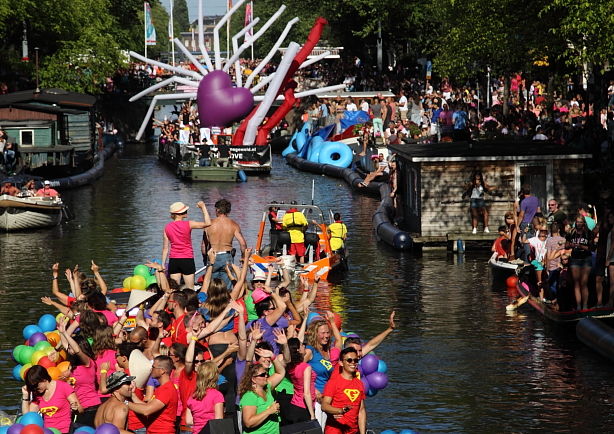
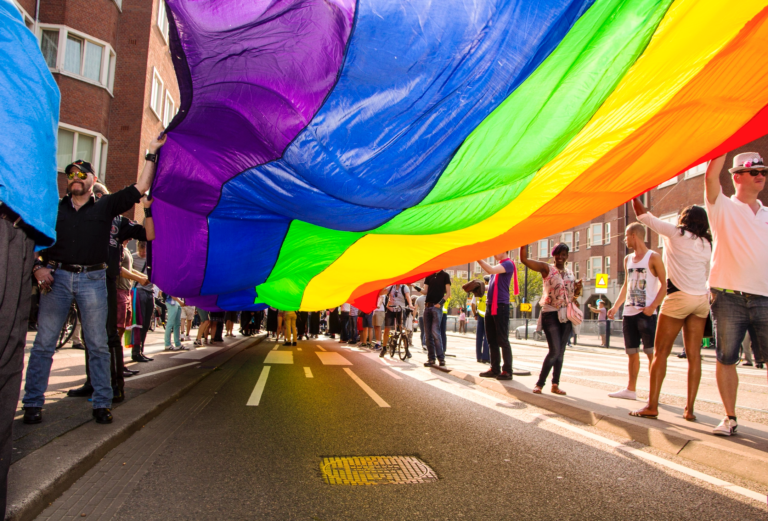
2012: On The Move
‘Bigger, better, more beautiful.’ That was how director Irene Hemelaar of Stichting ProGay described the 17th Pride, which concluded on Sunday with a final party at Rembrandtplein.
A key moment was the launch of the Pride Walk in collaboration with Stichting Homomonument (then called Tears of Pride Walk). This march focused on homophobia and respect and has been a permanent part of the Pride since 2012.
2011: All Together Now
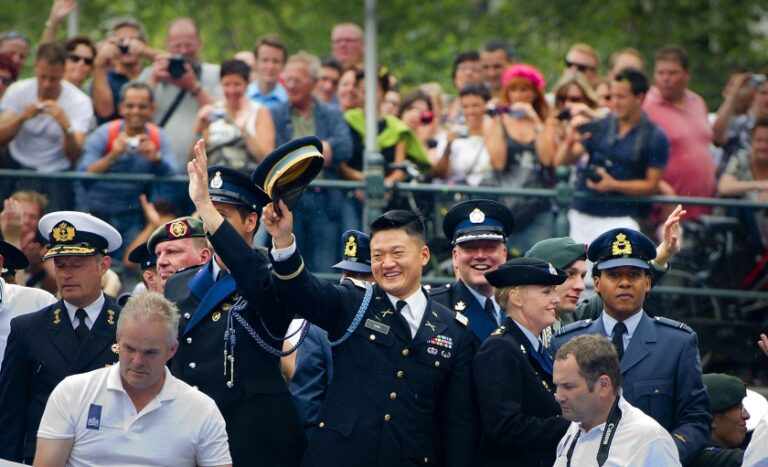
For the first time a vessel with uniformed military personnel from Defence sailed at the front of the boat parade. Former lieutenant Dan Choi from the U.S. and Royal Navy officer Mandy McBain were on that boat. Choi lost his job in the U.S. military after coming out and became a face of the American gay rights movement.
The Hindustani gay community also joined to break a taboo. Spectators lined the canals once again to watch often elaborately decorated boats and their crews.
Traditionally, Pride concluded on Sunday with a closing party on the square in front of the Stopera on the Amstel. In 2011 this celebration moved to the larger Rembrandtplein.
2010: Celebrate
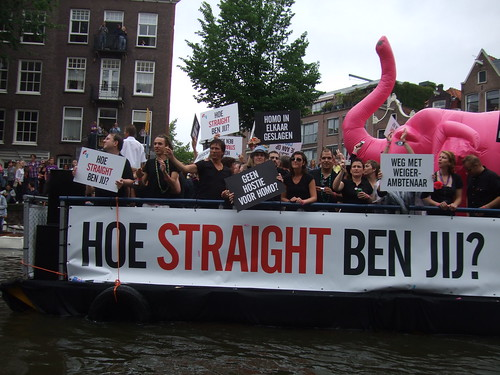
2010 was a less colourful year due to heavy rain, but hundreds of thousands of visitors still attended Pride. That year saw the first Polish boat and a pink delegation from the Dutch Railways (NS).
Many Dutch celebrities attended, including Patricia Paay, Job Cohen, Gerard Joling, Evert Santegoeds and Beau van Erven Dorens, who passed along Amsterdam’s canal belt.
2009: Extraordinary
The procession was opened by a boat from the municipality of Amsterdam. On this boat, during the parade, Mayor Cohen officiated the marriages of five Dutch-American LGBT+ couples. At the initiative of five Amsterdam schools, heterosexual youth participated for the first time on a Schools Boat.
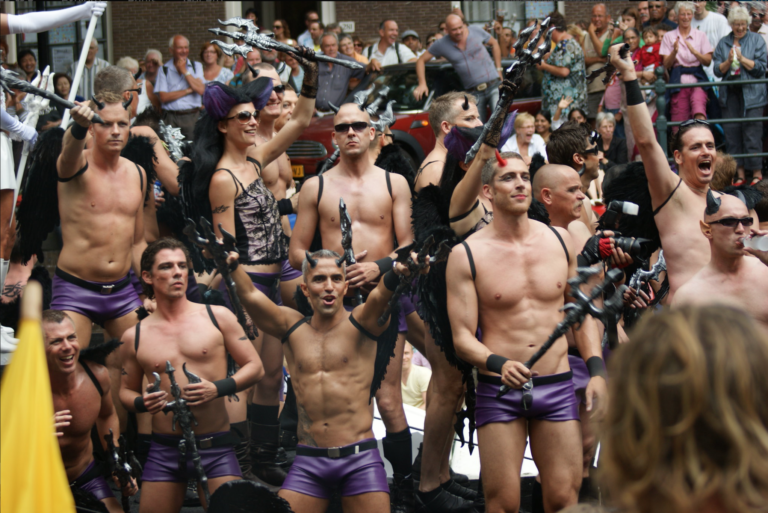
2008: Religion
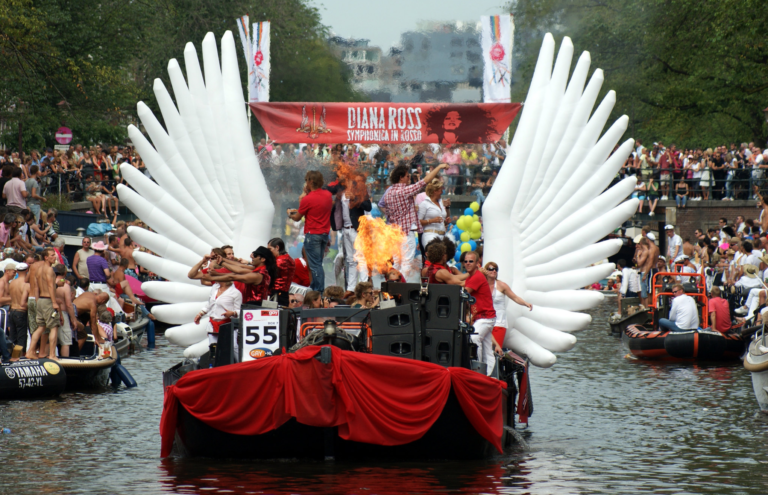
The city was pink, warm, and full. For the thirteenth time LGBT+ Amsterdam waved from the water to the city.
In the United States, Amsterdam Gay Pride was named the best Gay Pride celebration in Europe in 2008.
2007: Music and Dance
In 2007, under the leadership of Frank van Dalen (then Director), the name changed from Amsterdam Pride to Amsterdam Gay Pride. During the boat parade there was, for the first time, an ‘official’ boat with heterosexual participants, a boat with people with intellectual disabilities, and two boats with Amsterdam civil servants. Also for the first time a boat with gay people under 16 (Jong&OUT) participated.
Mayor Cohen was pleased so many boats had substantive themes. Cohen: “Colourful and tolerant! Amsterdam remains on the map as the Gay Capital of Europe, because we are and will continue to be.”
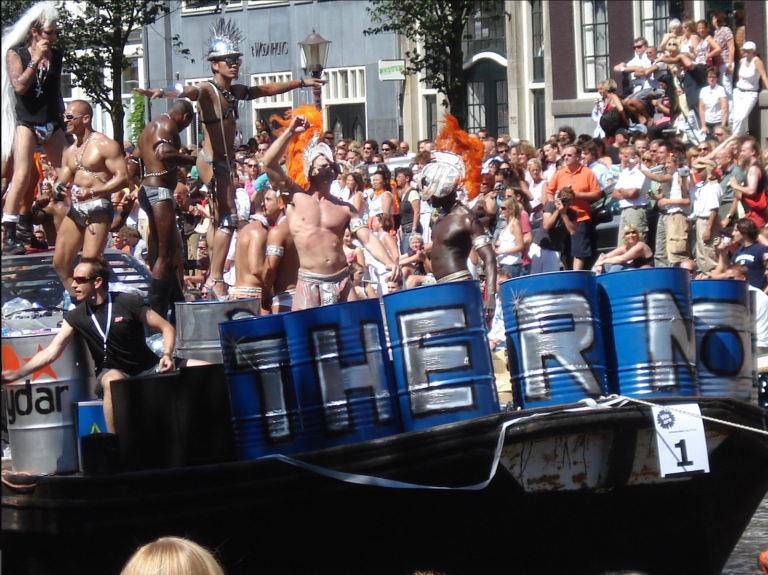
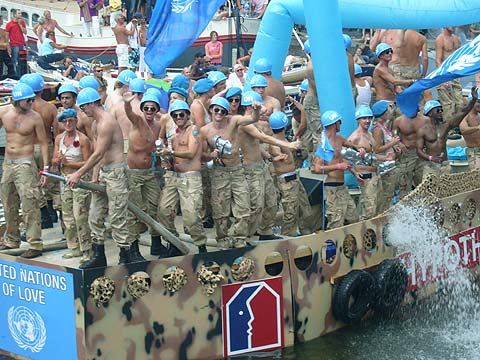
2006: Rembrandt
In 2006 Stichting ProGay took over from GBA. With chairman Hugo Braakhuis, Amsterdam and the organisation set a new course for Pride.
That year many social institutions participated, such as Humanitas, and political parties like GroenLinks and D66. Under the motto “Personal Pride – Company Pride” multinationals also joined, including Shell, ING, TNT, IBM and ABN/AMRO.
2005: Straight Ahead
The lead boat in the parade made a striking political statement. Using a large photo of two Iranian men who had been executed for their sexual orientation, it drew attention to LGBT+ acceptance elsewhere in the world and the steps still needed.
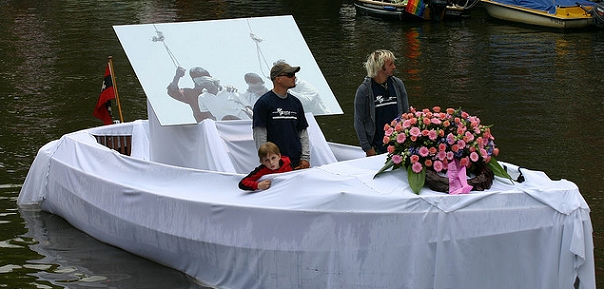
2004: Pride Goes International
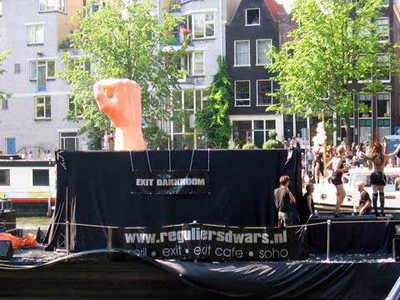
Rising municipal costs for permits and cleaning threatened the future of Amsterdam Pride, and there was a threat of bans on rainbow flags and darkrooms. In protest during the Canal Parade of 2004, the boat from April, Exit, Exit Café and Soho featured a demonstrative “darkroom” from which two enormous inflatable hands reached out.
2003: Nude with a wink
Organizer Siep de Haan of GBA called that year for more ‘nudity’ on the boats to counter prudishness in the city centre.
The call was not widely heeded, but Pride was again busy with more visitors than ever before.
2002: Lift Me Up
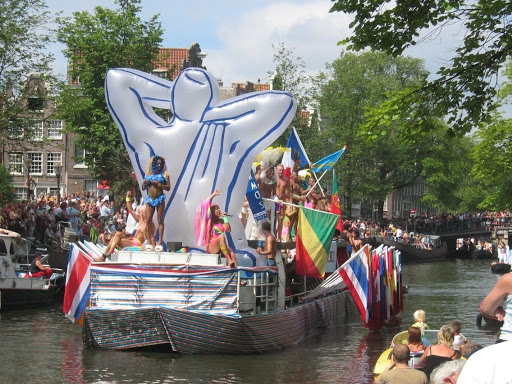
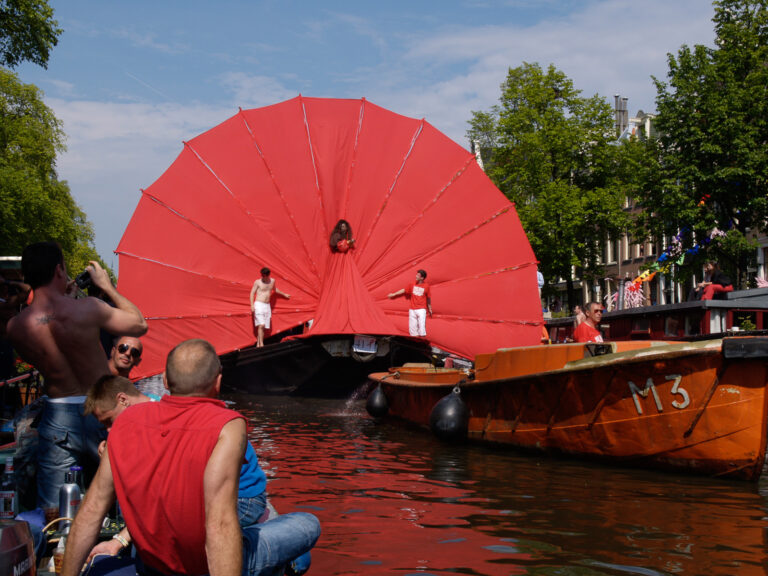
For the seventh time the Canal Parade was held in Amsterdam. By then it was receiving increasing global attention. The Red Cross sailed that year to draw attention to people living with HIV.
2001: Tolerance
For the first time boats participated from the Arab gay café Habibi Ana and the Jewish community Beit Ha’Chidush. That year also marked the opening of civil marriage to same-sex couples (Marriage Equality Act). The Netherlands was the first country in the world to open marriage, and then-Mayor of Amsterdam Job Cohen officiated the first same-sex marriage in the Stopera.
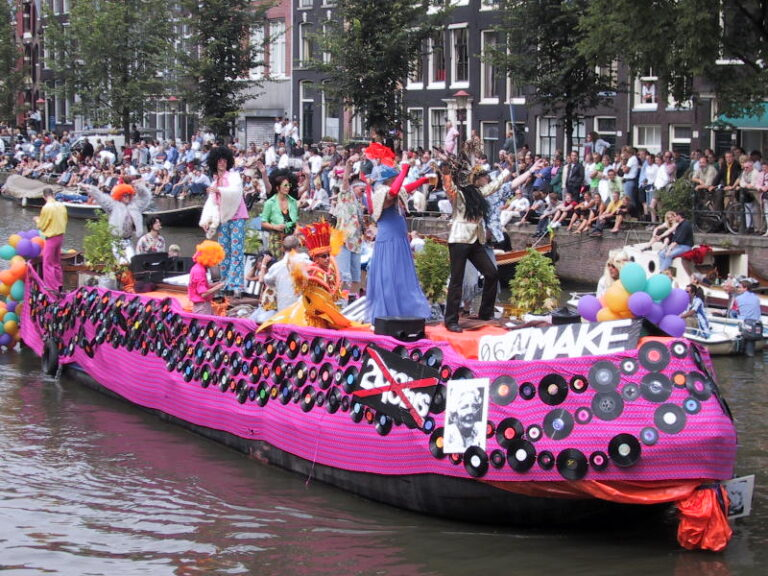
2000: 5-years of Pride
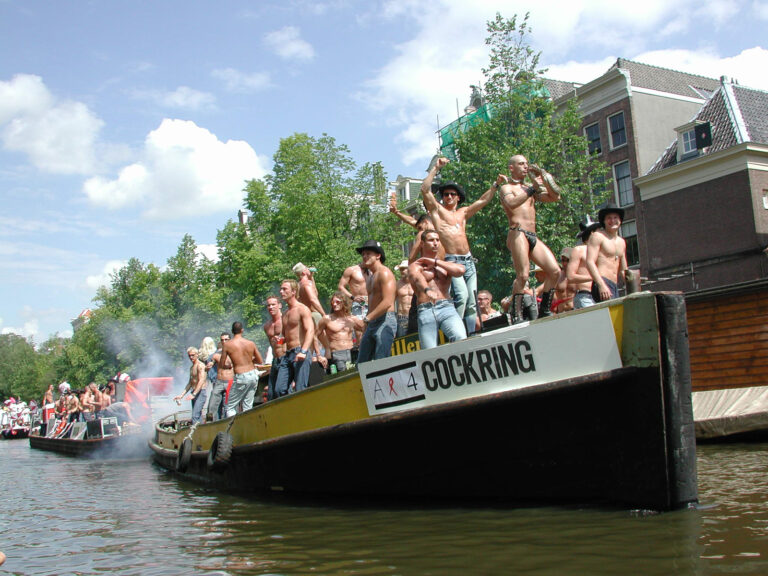
Entering the new millennium, the Canal Parade came under pressure. The municipal environmental service announced it would measure noise disturbance at houseboats rather than canal houses. Organizer Siep de Haan felt the rules were becoming too strict and warned only a ‘silent procession’ might then be possible.
In the Reguliersdwarsstraat the gay nightlife flourished, peaking at the Gay Pride street party on 5 August when the famous Australian pop singer Kylie Minogue performed there unexpectedly.
From 2000 (until 2003) a Drag King Contest took place in the COC building on Rozenstraat. As a counterpart to Drag Queen contests, this event was for women who dress as men, drawing attention to people who don’t like to be labelled strictly as male or female.
1999: Restart ‘Amsterdam Pride’
After the success in 1998 it was decided to continue ‘Amsterdam Pride’. In addition to the boat parade and street parties, cultural and sports activities were added to the programme. A limit of 80 participating boats was also introduced.
Despite a rainy weekend, an estimated one hundred thousand visitors lined the canals. At the end of the procession, a boat took part on behalf of, and in tribute to, the recently burned Club RoXY nightclub.
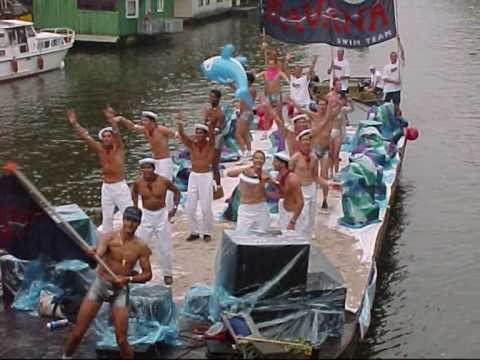
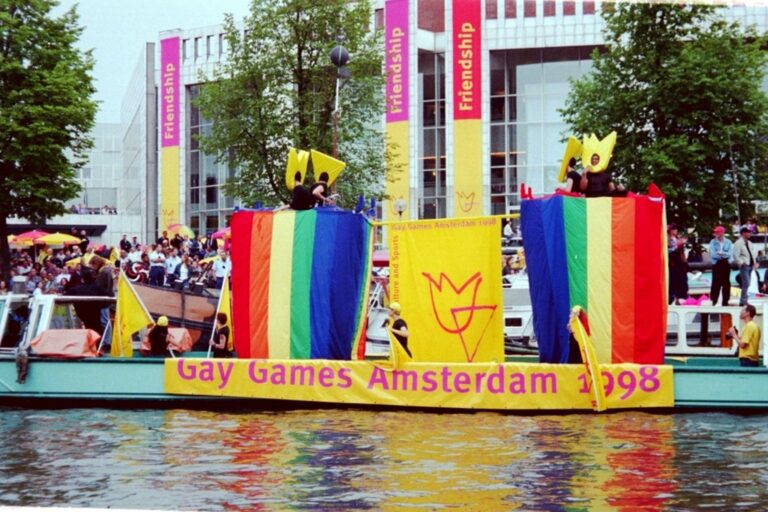
1998: Opening Gay Games
In 1998 the long-awaited Gay Games took place in Amsterdam and coincided with Gay Pride. The Gay Games were held outside North America for the first time and Amsterdam was the first European city chosen to host a week of sporting events. With over 14,000 athletes competing in some 30 sports and around 250,000 spectators from around the world, it became the largest LGBT+ celebration the Netherlands had seen to date.
During the Gay Games Amsterdam experienced an atmosphere of freedom and solidarity where LGBT+ people felt, for the first time, like the majority — a feeling that for many remained unmatched. The Gay Games were also celebrated with street parties on Warmoesstraat, Halvemaansteeg and, of course, Reguliersdwarsstraat.
Notably, KLM (the official sponsor of the Gay Games) also took part this year as the first major corporate.
1997: Dress rehearsal for the Gay Games
In 1997 the second boats parade was organised. It served as the dress rehearsal for the Gay Games to be held in 1998. Pride not only grew more visible but also attracted more visitors.
Amsterdam Pride initially lasted three days, with street parties on Friday and Saturday in Warmoesstraat, Halvemaansteeg, Kerkstraat, Paardenstraat and Reguliersdwarsstraat, and on Sunday a pink church service and the closing party.
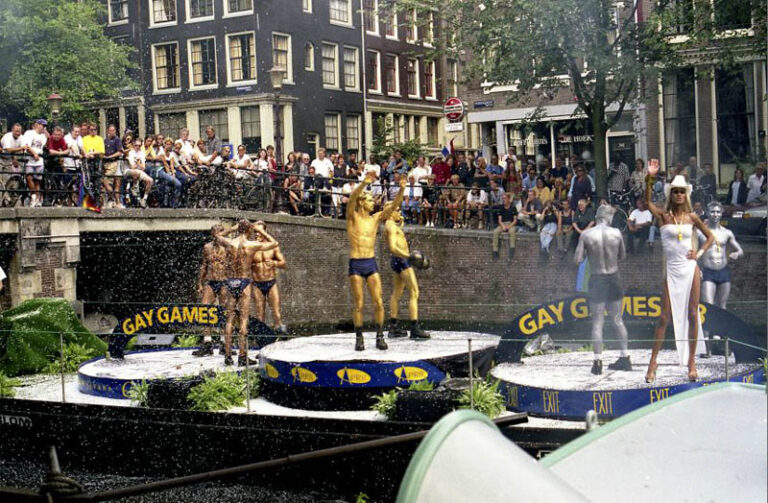
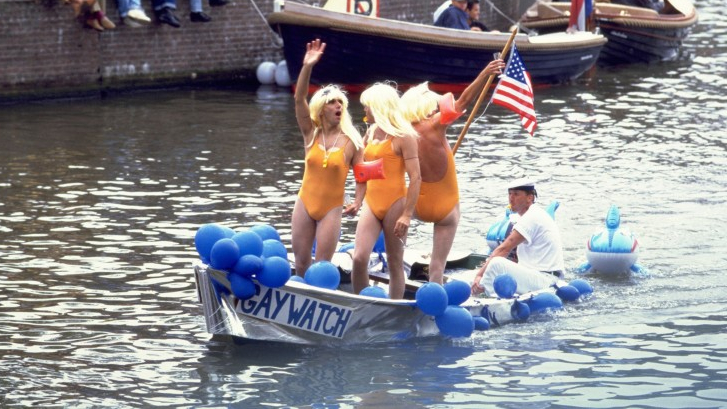
1996: Proud of Amsterdam
The very first boats parade on Amsterdam’s canals. That year’s theme: ‘Proud of Amsterdam’. Gay Business Amsterdam (GBA) decided, among other things, to organise a boats parade for Amsterdam Pride. Initially this Canal Parade was only supposed to be held three times, up to and including the Gay Games in 1998, but it proved so successful that it became an annual highlight of Amsterdam Pride.
More than 45 boats and barges took part in the first boats parade on 3 August 1996. At the request of the police, participants were required to sign a declaration of decency.
Amsterdam Pride was a celebration organised by gay nightlife entrepreneurs united in GBA to promote Amsterdam as a gay destination and to celebrate the freedom and diversity of our city (which remains embedded in the festival’s DNA). “It was a gift from the gay entrepreneurs to the city,” says GBA spokesperson Siep de Haan.